EMF meters are essential tools that help you find hidden radiation sources, test shielding effectiveness, and create a safer home environment. This guide will show you how to select the right meters and use them properly to get accurate readings.
Why Measure EMF?
Testing electromagnetic fields (EMF) in your home helps you find sources of radiation and check if your protection methods work. Without testing, you’re simply guessing about EMF levels. A good EMF meter lets you:
- Find hidden radiation sources
- Test the effectiveness of shielding products
- Decide where to place shielding
- Check if EMF levels are within safe ranges
- Create a baseline for future testing
Types of EMF Meters
The electromagnetic spectrum includes several different types of EMF that require specific meters to measure accurately. Many people ask if there’s a single meter that can measure everything. While there are several “3-in-1” meters on the market that can measure multiple types of EMF, specialized meters typically provide more accurate and detailed readings for each specific type.
RF (Radio Frequency) Meters
What they measure: Wireless radiation from 20 MHz to 8+ GHz (frequencies allocated for wireless communications per the US Spectrum Allocation Chart), including:
- Cell phones and towers
- Wi-Fi routers
- Smart meters
- Bluetooth devices
- Cordless phones
- Baby monitors
- Microwave ovens
Popular models:
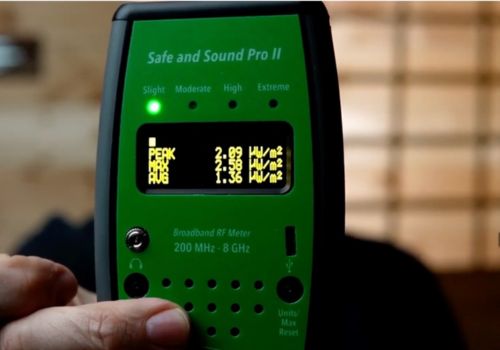
- Safe and Sound Pro II (measures up to 8 GHz)
- Safe and Sound Pro mmWave Meter (specialized for high-band 5G frequencies from 18-90 GHz)
- Cornet ED88TPlus (measures up to 8 GHz)
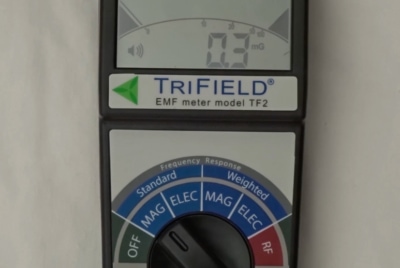
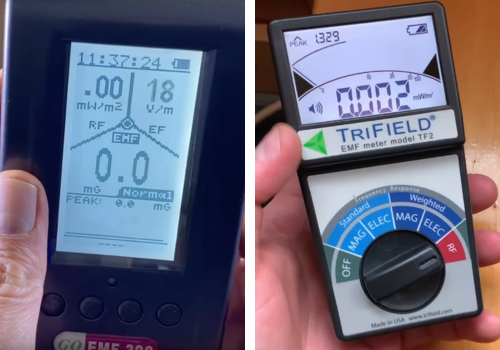
- TriField TF2 (measures up to 6 GHz)
What to look for:
- Frequency range (higher is better to capture 5G signals)
- Peak and average readings
- Audio feedback option
- Clear display
5G Measurement Considerations: The new Safe and Sound Pro mmWave Meter is specially designed to measure high-band 5G frequencies (18-90 GHz) that standard RF meters cannot detect. As 5G networks expand, these higher frequencies are becoming more common in urban areas and need specialized equipment to measure properly.
Magnetic Field Meters
What they measure: Magnetic fields from 50-60 Hz sources like:
- Power lines
- Electrical panels
- Appliance motors
- Transformers
- Wiring errors
Popular models:
- Gigahertz NFA1000 (3-axis measurement)
- TriField TF2
- Cornet ED88TPlus (limited function)
What to look for:
- 3-axis measurement for accuracy
- Units in milligauss (mG) or nanotesla (nT)
- Wide measurement range
Electric Field Meters
What they measure: Electric fields from 50-60 Hz sources like:
- Unshielded wiring
- Lamps and light fixtures
- Extension cords
- Electrical outlets
Popular models:
What to look for:
- Body voltage measurement ability
- Wide measurement range
- 3-axis measurement when possible
Dirty Electricity Meters
What they measure: High-frequency voltage transients on electrical wiring, caused by:
- Dimmer switches
- Solar inverters
- LED and CFL bulbs
- Variable speed motors
- Smart appliances
Popular models:
What to look for:
- Ease of use
- Clear reading display
- Compatibility with filters
For more detailed information about selecting the right EMF meter for your needs, visit our comprehensive guide: Best EMF Meters and Detectors.
If you’re specifically interested in dirty electricity meters, we have a specialized guide on that topic: Best Dirty Electricity Meters.
How to Test Your Home
Testing your home for EMF requires a systematic approach rather than random spot checks, which can miss important radiation sources and exposure patterns.
Basic EMF Testing Process
- Create a testing plan:
- Draw a simple map of your home
- Mark key testing locations
- Test at different times of day
- Test before and after installing protection
- Test with devices both on and off:
- Some devices emit when “off” but still plugged in
- Some emit only when actively used (like cell phones)
- Some emit on regular intervals (like smart meters)
- Record your findings:
- Note readings in different locations
- Take photos of meter readings for reference
- Create a spreadsheet to track changes over time
- Focus on sleeping areas first:
- We spend about one-third of our lives in bed
- Nighttime is when the body repairs and heals
- Aim for the lowest possible readings in bedrooms
For more detailed guidance on reducing EMF in your bedroom, check out our comprehensive guide: How to Reduce EMF in Your Bedroom.
Room-By-Room Testing Tips
Bedroom:
- Test your bed at head, middle, and foot positions
- Check all four walls for hidden wiring
- Test all electronic devices around your bed
- Measure at night when more devices are active in nearby homes
Home Office:
- Test at the chair where you sit
- Measure computers, monitors, and printers
- Check routers and networking equipment
- Test wired vs. battery-powered equipment
Kitchen:
- Test major appliances when running and idle
- Check for dirty electricity from refrigerators and microwaves
- Measure at the sink (plumbing can carry current)
- Test at food prep areas where you spend time
Living Areas:
- Test entertainment centers and smart TVs
- Check smart home devices
- Measure at common sitting locations
- Test any exercise equipment with motors or electronics
Testing Before and After Shielding
- Baseline testing:
- Measure and record EMF levels before adding any protection
- Take multiple readings at different times
- Note typical high and low readings
- Shielding verification:
- After installing protection, test in the same exact spots
- Calculate the percentage reduction
- Test on different days and times for consistency
- Long-term monitoring:
- Retest every few months
- Check after adding new electronics
- Verify shielding effectiveness hasn’t decreased
Understanding EMF Readings
Making sense of your meter readings is crucial for determining which EMF levels need attention and which are within acceptable ranges for your health goals.
Safe Level Guidelines
Different organizations suggest varying safety levels. Here are some common guidelines:
RF Radiation:
- Building Biology Guidelines (sleeping areas):
- Below 0.1 µW/m² (microwatts per square meter): No concern
- 0.1-10 µW/m²: Slight concern
- 10-1000 µW/m²: Severe concern
- Above 1000 µW/m²: Extreme concern
Magnetic Fields:
- Building Biology Guidelines (sleeping areas):
- Below 0.2 mG (milligauss): No concern
- 0.2-1.0 mG: Slight concern
- 1.0-5.0 mG: Severe concern
- Above 5.0 mG: Extreme concern
Electric Fields:
- Building Biology Guidelines (sleeping areas):
- Below 0.3 V/m (volts per meter): No concern
- 0.3-1.5 V/m: Slight concern
- 1.5-10 V/m: Severe concern
- Above 10 V/m: Extreme concern
Dirty Electricity:
- Below 25 GS units (Graham-Stetzer): Generally considered good
- 25-50 GS units: Moderate concern
- Above 50 GS units: High concern
How to Interpret Readings
When reviewing your test results, keep these important factors in mind:
- Context matters:
- Higher readings expected near appliances
- Lower readings needed in sleeping areas
- Brief exposure less concerning than constant exposure
- Distance effect:
- RF and magnetic fields drop quickly with distance
- Moving just a few feet away can dramatically reduce exposure
- Use this principle when arranging furniture
- Time factors:
- EMF can vary throughout the day
- Neighbors’ usage affects your readings
- Smart meters often pulse at specific intervals
- Combined exposures:
- Multiple types of EMF can have combined effects
- Check for all types, not just one
- Address highest readings first
Common Testing Mistakes to Avoid
- Testing too quickly:
- Move slowly to catch fluctuating signals
- Hold in position for 15-30 seconds
- Watch for peak readings
- Body interference:
- Your body can block RF signals
- Hold meter away from your body
- Test from multiple angles
- Single-point testing:
- EMF can vary within inches
- Scan entire areas, not just single points
- Move the meter up/down and side-to-side
- Ignoring height:
- Test at body height when standing
- Test at mattress height for beds
- Test at seated height for chairs and desks
- Forgetting time factors:
- Some signals pulse or vary over time
- Smart meters often transmit in bursts
- Test at different times of day
Choosing Your First EMF Meter
Selecting the right EMF meter depends on your specific concerns, technical comfort level, and budget, with options ranging from basic 3-in-1 devices to specialized professional equipment.
For Beginners on a Budget
If you’re new to EMF testing and have a limited budget, start with one of these options:
Option 1: TriField TF2 ($168)
- Measures RF, magnetic, and electric fields
- Easy to use with analog display
- Good introductory meter
- Limited RF sensitivity and frequency range
Option 2: Cornet ED88TPlus ($180)
- Good RF detection up to 8 GHz
- Basic magnetic and electric field testing
- Digital display with graph function
- Sound feature to identify sources
For Serious Testing
If you need accurate readings across all types of EMF:
RF Testing: Safe and Sound Pro II ($370)
- Professional-grade RF meter
- Measures up to 8 GHz (including low and mid-band 5G)
- Extremely sensitive for low readings
- Shows peak and average readings
5G High-Band Testing: Safe and Sound Pro mmWave Meter ($499)
- Specialized for high-band 5G frequencies (18-90 GHz)
- Essential for testing in areas with mmWave 5G deployment
- Detects signals that standard RF meters cannot measure
- Professional-grade accuracy
Magnetic/Electric Fields: Gigahertz NFA1000 ($1,700)
- Professional 3D measurement
- Data logging capability
- Extremely accurate for sleeping area assessment
- Can measure body voltage with accessories
Conclusion
Proper EMF testing is essential to understand your exposure and verify that protection methods work. Even a basic meter is better than no testing at all. Start with the areas where you spend the most time, particularly your bedroom, and expand your testing as you address each area.
Remember that EMF testing is not a one-time task but an ongoing process. As you add new devices, make changes to your home, or as neighbors change their technology use, your EMF environment will change too. Regular testing helps you stay aware of your exposure and maintain a low-EMF living space.
For the most accurate assessment, consider hiring a professional EMF consultant for an initial evaluation, then use your own meters for ongoing monitoring.